

Common processing technologies for alloy material 1.7225 (Equivalent grade 42CrMo4) include the following:
- Cutting:
- Turning: It can be used to process the outer circle, inner hole, end face, etc. of shaft and disc parts.
- Milling: It is used to process planes, steps, grooves, formed surfaces, etc.
- Drilling: It is used to drill holes.
- Boring: It processes inner holes to improve the dimensional accuracy and surface quality of inner holes.
During cutting, it is necessary to select suitable tool materials and geometric parameters, and reasonably set cutting parameters such as cutting speed, feed rate and cutting depth to ensure processing quality and efficiency.
2. Hot working:
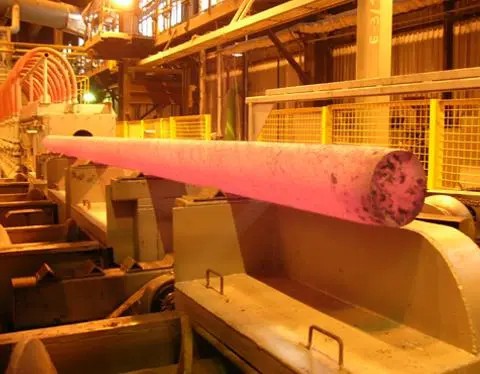
- Forging: By heating and forging the material, its shape and internal structure are changed to improve the performance and mechanical properties of the material. The forging temperature is usually in the range of 850-1200°C.
- Hot rolling: The material is rolled into profiles such as plates, bars, and pipes through a rolling mill at high temperature.
3. Heat treatment:
- Annealing: Heat the material to a certain temperature (usually 820 - 860°C), keep it warm for a period of time, and then slowly cool it to reduce the hardness of the material, improve the cutting performance, and eliminate internal stress.
- Normalizing: Heat to 840 - 880°C, air cool, which can refine the grains and improve the strength and toughness of the material.
- Quenching: Heat to 830 - 860°C, and quickly cool (usually oil cooling or water cooling) to make the material have high hardness and high strength.
- Tempering: After quenching, tempering treatment is usually performed at a temperature of 540 - 680°C to reduce quenching internal stress, improve toughness and plasticity, and stabilize the size and performance of the material.
4. Welding:
Welding is performed by gas shielded welding (such as argon arc welding, carbon dioxide gas shielded welding), manual arc welding and other methods. The welding area needs to be preheated before welding, and appropriate heat treatment is performed after welding to eliminate welding residual stress and improve the performance of the welded joint.
5. Cold working:
- Cold drawing: Through drawing, the material undergoes plastic deformation, which improves the strength and hardness of the material and allows precise size and shape to be obtained.
- Cold rolling: Used to produce thin plates, thin-walled tubes and other products.
Material 1.7225 (42CrMo4) Advantages and Disadvantages:
- Advantages:
High strength: After proper heat treatment, 1.7225 material can reach a higher strength level, enabling it to withstand greater loads and stresses, and is suitable for manufacturing heavy-duty mechanical parts and structural parts.
Good toughness and ductility: While having high strength, it also has good toughness and ductility, making it less likely to suffer brittle fracture when subjected to impact and vibration, and has a certain impact resistance.
Excellent fatigue performance: It can maintain good performance under cyclic loads, has a long fatigue life, and is suitable for manufacturing parts that withstand alternating loads, such as drive shafts, crankshafts, etc.
Good hardenability: This means that during the quenching process, the material can obtain uniform hardness and mechanical properties on a larger cross-section, making the performance of the parts more consistent in different parts.
Wear resistance: The surface has certain wear resistance and can be used to manufacture some parts that require wear resistance, such as gears, ball screws, etc.
Machinability: It has good cutting and hot processing performance, and is relatively easy to process into parts of various shapes and sizes.
Welding performance: It has good welding performance under certain conditions. By selecting appropriate welding methods and process parameters, a welded joint with good performance can be obtained.
- Disadvantages:
Welding difficulty: Although it has certain weldability, if the process is improper during welding, problems such as welding cracks and embrittlement are prone to occur, and the welding process and parameters need to be strictly controlled.
High heat treatment requirements: In order to obtain ideal performance, parameters such as heating temperature, holding time and cooling rate during heat treatment need to be accurately controlled, otherwise unsatisfactory performance may result.
High cost: Due to the addition of alloying elements and complex processing and heat treatment processes, the cost of 1.7225 alloy material is relatively high.
Limited corrosion resistance: Compared with some stainless steels or corrosion-resistant alloys, 1.7225 has poor corrosion resistance and is prone to corrosion in some corrosive environments.


