

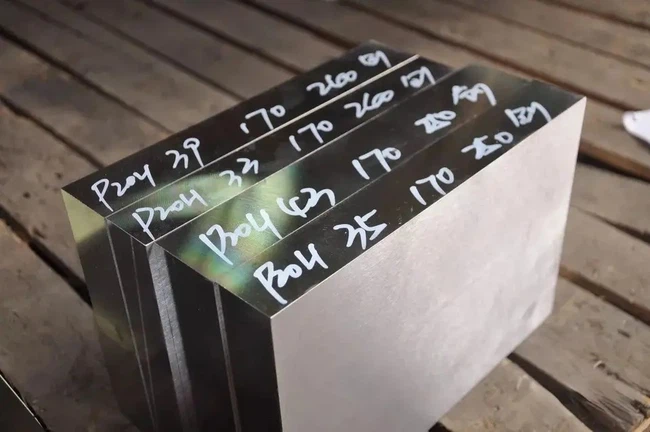
AISI P20 steel plate material is a multi-functional low alloy Tool steel, which is characterized by good toughness at medium strength level. Special purpose die steel P20 steel plate is usually used for Injection mold construction cavity and mold as well as zinc die-casting mold. The P20 mold steel plate material is usually sold in a pre hardened state with a hardness of approximately 300 HBW.
P20 Tool steel varies in different countries and regions. In Europe, DIN specification DIN EN ISO 4957 standard materials (1.2311 and 1.2312) are generally used, while in the Japanese steel industry standard, PX5 is the new standard P20. In American countries, P20 grade steel is the most commonly used and widely used steel grade material. In China, 3CrM2Mo is equivalent to P20 steel grade in GB/T 1299
- Tool steel specification.
AISI P20 Tool steel is nitrided or carburized. These P20 mold steel materials can be processed into complex large molds. Material P20 steel plate and round rod are mostly used in the carburized state. The presence of chromium and nickel enhances the toughness and hardness of P20 grade die steel materials.
- ASTM P20 Die Tool steel Properties
Physical property
Density: 0.284 lb/in3 (7861 kg/m3)
Specific gravity: 7.86
Elastic modulus: 30 x 106 psi (207 GPa)
Thermal conductivity:
24 Btu/ft/h/° F
41.5 watts/meter/° K
Machinability: 60-65% of 1% carbon steel
- Forging of P20 steel plate mold steel
AISI P20 steel plate and round bar material are forged at 1093 ° C (2000 ° F) to 899 ° C (1650 ° F). For these steel P20 materials, forging at temperatures below 871 ° C (1600 ° F) is not recommended.
- Heat treatment of Tool steel P20 material
Stress relief
Preheating: Because the mold steel P20 steel plate is sold in a pre hardened state, there is no need for hardening heat treatment. After intermittent processing and during use, the thermal stress of the steel must be eliminated by heating to 900 º F (482 º C), equalizing the thickness per inch (25.4 mm), and holding it for one hour, then cooling it in air to ambient temperature.
In rare cases where AISI steel P20 must be re hardened, the steel must be annealed before hardening.
Hardening
Critical temperature: Ac1:1405 º F (763 º C)
Preheating of P20 metal: Heat at a rate not exceeding 400 º F (222 º C) per hour to 1150-1250 º F (621-677 º C) and equalize.
Austenitization (high temperature)
Rapid heating from preheating to 1550 º F (843 ° C). Soak the first inch (25.4 mm) of thickness for 30 minutes, with each additional inch (25.4 mm) soaked for 15 minutes.
Quenching
Pressurize the gas or interrupt the oil to reach 150-125 º F (66-51 º C).
For oil, quench to black at approximately 900 ° F (482 ° C) and then cool to 150-125 ° F (66-51 ° C) in still air.
Tempering
P20 Tool steel is tempered at 482-593 ° C (900 to 1100 ° F) with Rockwell hardness C of 37 to 28.
Annealing
AISI P20 Tool steel is annealed at 760-788 ° C (1400 to 1450 ° F) and then slowly cooled in the furnace at a temperature below 4 ° C (40 ° F) per hour.
- Application of P20 Steel Plate or Bar
P20 Tool steel is used for cryogenic applications, including Injection mold construction and die-casting molds. The main uses of P20 steel plates and bars:
Plastic molds, mold supports, backplates, plungers for plastic pressure molds, hydraulic forming mold tools. Base plate, mold support. It is also suitable for other applications, such as guide rails, shafts, and wear strips.


