

Nickel-based alloy refers to a kind of alloy with high strength and certain oxidation and corrosion resistance at 650~1000 ℃, including nickel-based heat-resistant alloy, nickel-based corrosion-resistant alloy, nickel-based wear-resistant alloy, nickel-based precision alloy and nickel-based shape memory alloy. They all have very important applications, such as nickel-based superalloys, which are often used in manufacturing aero-engine blades and rocket engines, nuclear reactors, energy conversion equipment, etc., and serve the high-end fields of aviation, power generation, national defense, medical treatment and nuclear industry.
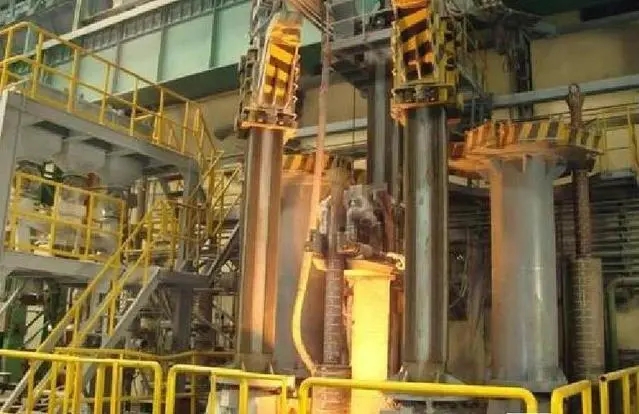
Due to the high melting point of the original components of the nickel-based alloy and the high requirement for its purity, the nickel-based alloy smelting process is different from the conventional smelting method, which is very unique. The summary is as follows:
1. Vacuum induction melting (VIM)
Vacuum induction melting (VIM) is a method of smelting by using electromagnetic induction to generate eddy current in metal conductors to heat furnace charge under vacuum conditions.
VIM can provide the maximum control of chemical composition to prevent the contact of molten liquid with hydrogen, oxygen and nitrogen in the atmosphere. Electromagnetic stirring can not only make the molten liquid uniform, but also continuously bring the reactants to the melt and vacuum interface, so that the subsequent refining reaction can proceed smoothly. The gas content and the volatilization and precipitation of non-metallic inclusions can greatly improve the mechanical properties of most superalloys.
VIM furnace is an important smelting equipment for the production of nickel-base superalloys, corrosion-resistant alloys and other special alloy materials. Especially for alloys containing more active elements such as aluminum and titanium, vacuum induction melting must be adopted.
2. Electroslag remelting (ESR)
Electroslag remelting (ESR) is a method of smelting by using the resistance heat generated when the current passes through the molten slag as the heat source. It is that the current passes through the resistance heat of the liquid slag pool to melt the metal electrode, and the molten metal converges into droplets. When the droplets fall, they pass through the slag layer and enter the metal molten pool, and then crystallize and solidify into steel ingots in the water-cooled crystallizer. Electroslag metallurgy is an important means of producing high-quality materials at present. It combines high-temperature melting, chemical refining and condensation crystallization to produce high-quality ingots. It has the advantages of high purity, low sulfur content, less non-metallic inclusions, smooth surface of ingots, uniform and dense crystallization, uniform metallographic structure and chemical composition, and is widely used in aerospace, military, energy, shipbuilding, electronics, petrochemical Heavy machinery and transportation are important areas of the national economy.
3. Vacuum consumable arc melting (VAR)
Vacuum Arc Remelting (VAR) is to use DC power supply to generate an arc between the electrode and the copper crucible base plate placed in the water jacket under vacuum. The arc heating generates high heat, melting the electrode, melting the electrode and forming a molten pool in the water-cooled copper crucible. The molten metal completes rapid solidification, crystallization and solidification into ingots.
Vacuum arc smelting is generally used to refine easily oxidizable metals and alloys such as stainless steel, superalloy, titanium zirconium tantalum niobium tungsten molybdenum, etc., which reduces the loss of active elements (such as Al and Ti), and the ingot solidification process is controllable, significantly improving the cleanliness, uniformity, fatigue resistance and fracture toughness of the ingot. Therefore, the consistency and uniformity of its structure is good, the number of inclusions is small, and the purity of the alloy is further improved. Vacuum arc smelting is very suitable for smelting special steel, active and refractory metals such as titanium, molybdenum and niobium.
It is noteworthy that most special materials such as high quality superalloys and corrosion-resistant alloys at home and abroad are produced not by a single process, but by a double or triple process, that is, by vacuum induction furnace+electroslag remelting furnace (VIM+ESR) or vacuum induction furnace+vacuum consumable furnace (VIM+VAR). There are also a few harsh industries, such as military products, which are produced by (VIM+ESR+VAR).


